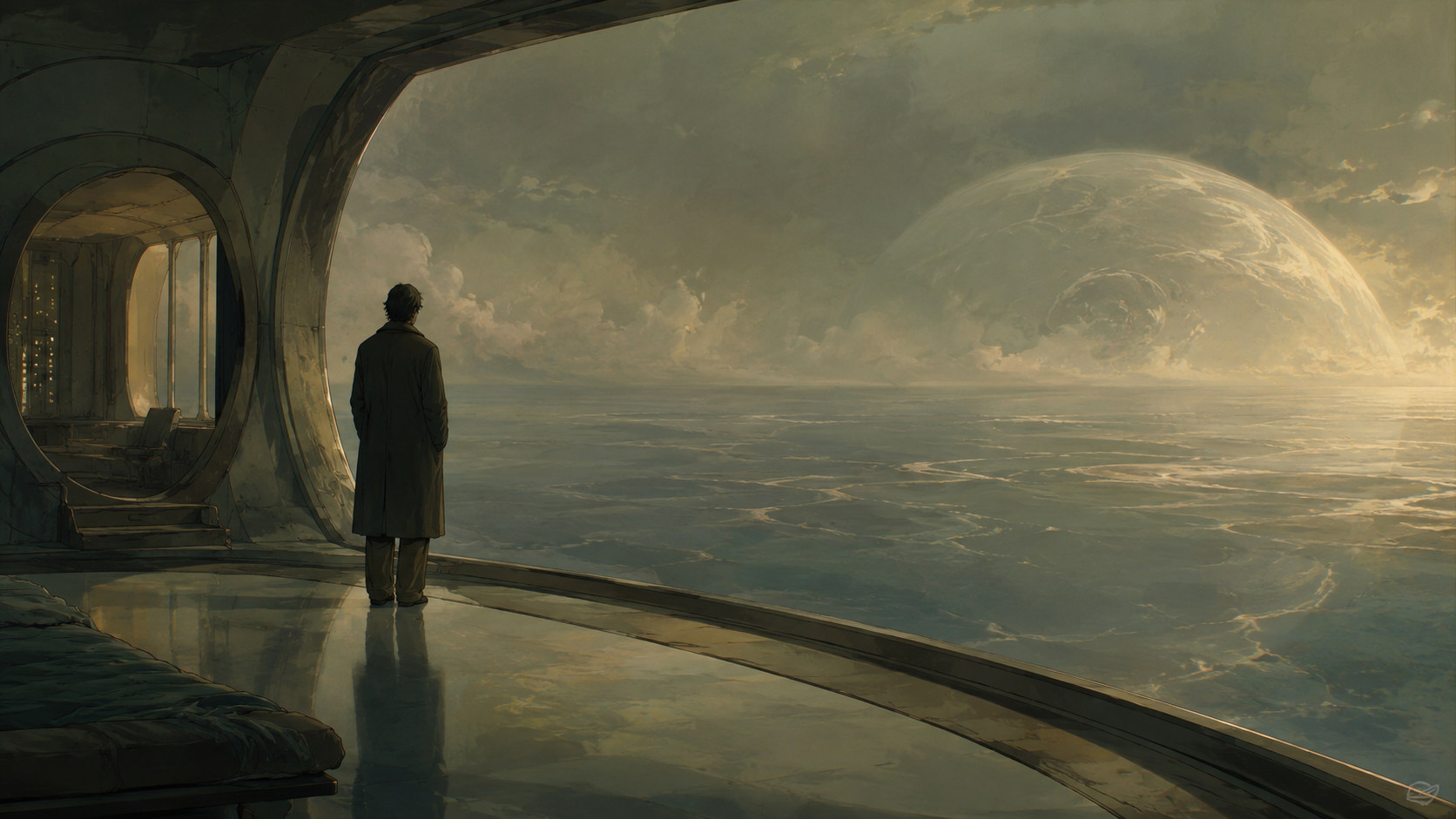
Solaris: The Grief We Keep Sending into Space
I have/had… let’s say I have… a friend who absolutely loved Tarkovsky’s cinema.
Growing up with him, we had this small ritual… we used to sit for hours at a local bar [we call it Ahata], and we used to either order a few extra beers that our bladders could process or 2 steel glass for Old Monk. Our usual conversations never touched our actual lives. It’s not that we never talked about our lives… we did, but it all came down to movies, cinema, and books. If he wanted to tell me something he was struggling with, he would talk about Anurag Kashyap or Bergman. If I wanted to tell him my failed attempts to impress a publisher, we both would talk about Prem Chand or Rowling. That was the whole arrangement, and trust me when I say this, it worked for close to 15-17 years until it didn’t.
Anyway, during one of those sittings, when we both were half drowned in Old Monk, and the air was filled with my Marlboro, he leaned across the table and said, “Bhai, Tarkovsky kya aadmi tha bhenchod!” Brother, what a man Tarkovsky was dammit!
Now I knew that he was blabbering like he always did after emptying the rum, so I nodded and the night passed. A few months later, life did what it always did, and somehow we both parted. Sadly, we both have not spoken to one another ever since.
Then last birthday, when I was rewriting my own science fiction novel [what would later become the third draft and what I would say to Shivani (my friend from North) — I hope this is the last draft… it will not be!], I somehow remembered that conversation with my friend. I immediately turned to Amazon and ordered the entire Tarkovsky filmography in one go.
The first film I watched was Solaris.
I thought I was buying science fiction. I was buying a 166-minute film about grief that happens to be set in space.
What Actually Happens on That Space Station? [SPOILER AHEAD]
For those who have never seen it, the plot of Solaris (1972) is simple to describe and impossible to summarize.
Kris Kelvin, a psychologist, travels to a research station orbiting Solaris, a planet covered entirely by an ocean that appears to be a single living, thinking organism. By the time Kelvin arrives, only two scientists remain on board, Snaut and Sartorius, and both behave as if they both have seen something they cannot file under any known category of experience. A third, Gibarian, has died by suicide shortly before Kelvin’s arrival, leaving behind a recorded message that explains nothing and warns of everything.

Then Kelvin goes to sleep, and when he wakes up, his wife Hari is in the room with him.
Hari died 10 years ago. She died by suicide after Kelvin walked out on her, and he has carried that specific pain for a decade. And yet here she is, warm, breathing, confused, wearing the dress he remembers. The ocean, it turns out, reads the minds of the people orbiting it and sends them “visitors” assembled from their most guarded memories. It does this without explanation and without malice.
When I first became Kelvin (trust me, you will, too), his first response told me everything about how humans handle grief. He tricks this resurrected Hari into a rocket and fires her into space. The next night, she is back, with no memory of the launch, asking him why he looks so frightened.
The rest of the film watches Kelvin fall in love with a copy of his dead wife while the copy slowly discovers that SHE IS A COPY. Hari learns that she only knows what Kelvin remembers about her, that her insides are built from his memory and nothing else, and the discovery destroys her. She drinks liquid oxygen to end herself, and her body convulses back to life in one of the most disturbing resurrection scenes ever filmed, because the ocean will not let Kelvin’s grief die even when the grief itself begs to.
Stanisław Lem, who wrote the 1961 novel the film is based on, reportedly hated what Tarkovsky did with it. Lem had written a book about the limits of human knowledge, about our inability to comprehend a truly alien intelligence, and he grumbled that Tarkovsky had ignored the cosmos entirely and filmed something closer to a Russian novel of guilt and conscience. He was right, and I think that is precisely why the film has outlived the argument. Tarkovsky had seen Kubrick’s 2001 and found it cold, a technological display with no human pulse, and he set out to make its opposite: a space film where the most advanced object on screen is a man’s regret.
And… I wish I could tell my friend this — Bhai, even I attempted the latter in my science-fiction novel!
What Would Freud and Didion See on That Station?
Here is a coincidence I cannot stop thinking about.
Lem published Solaris in 1961. That same year, C.S. Lewis published A Grief Observed, his raw notebook written after his wife’s death. There’s a line that I freaking love, and it is something that I keep going to: “No one ever told me that grief felt so like fear.”
So there were two men, in the same year, on opposite sides of the Iron Curtain, who wrote about a presence that returns after death and refuses to behave. One called it an alien ocean. The other called it God, or the absence of God, depending on the page or depending on the Old Monk glass.
Once you start reading the literature of grief seriously, Solaris stops looking like science fiction at all. It starts looking like a filmed syllabus.
Freud, in his 1917 essay ‘Mourning and Melancholia,’ described mourning as slow, deliberate work. The griever detaches from the lost person piece by piece, memory by memory, and the psyche resists every detachment because abandoning the dead feels like betrayal. Melancholia, in Freud’s framing, is what happens when the work refuses to finish, when the lost person gets absorbed into the self and lives there forever.
Now this is my take: Look at Kelvin. His first instinct is to complete the entire work of mourning in one rocket launch, and the ocean responds by returning Hari the very next night. Hahah! Please note that grief does not accept lump-sum payments.
Joan Didion, in ‘The Year of Magical Thinking,’ confessed that after her husband died, she could not give away his shoes, because some functioning part of her brain believed he would need them when he came back. She called this magical thinking and admitted that the griever is, for a period, quietly and functionally insane while appearing normal at dinner parties. The ocean of Solaris is magical thinking given infrastructure. It performs, with alien machinery, the exact operation Didion’s mind performed with a shoe rack: it keeps the dead ready, because they might return.
There’s a reason why I bold the above line. Oh! I wish I could tell you the reason today. But someday for sure…
So, this is what Solaris taught me:
We never grieve the whole person. We grieve our copy of them, and the copy is always incomplete. Tarkovsky simply built the copy a body and let her walk around the station discovering her own edges. When Hari understands what she is, she tries to die of it.
The philosopher Denise Riley, after losing her son, wrote that grief removed her from time itself, that she lived in a stopped present where the ordinary flow of days simply did not apply to her anymore. The station in Solaris has no sunrise. The visitors return every night on a loop. Kelvin’s days do not advance so much as repeat. Riley would have found the set design accurate.
Why Is Science Fiction the Only Genre with Enough Room?
This brings me to the actual thought that has been circling my head since that first viewing, the reason I am writing this essay at all.
Realist fiction cannot hold grief at full strength, because realist fiction is contractually obligated to keep the dead in the ground.
A literary novel about a grieving man must route everything through plausibility: he can weep, drink, remember, deteriorate, recover. What he cannot do is wake up and find her in the room. And yet that is precisely what grief feels like from the inside. The griever’s lived experience violates realism daily, hears the dead in the hallway, sets their plate, keeps their shoes. Realist fiction can only ever depict grief from the outside, at the exact moment the griever is having an experience that realism forbids.
I gave seven years of my life writing this book, and what I understood from the process is a very simple fact:
Science fiction is the only genre where the interior physics of grief can be staged as a literal, external event without the story collapsing. The dead can return, and the genre absorbs it. Memory can become matter. Time can loop. The impossible thing the griever privately believes can simply happen on screen (and in my case, on paper), and we accept it, because we agreed at the door that the rules would be different here. The genre has more room because it borrowed the dimensions of the universe, and grief, as anyone who has carried it knows, requires exactly that much space.
But I want to confess something today: I understood this about my own novel embarrassingly late.
Yes, I wrote science fiction. Yes, my story travels to worlds beyond the wormhole. But somewhere around that third draft, I noticed that grief never once left Dev’s side, that it had been walking beside him through every chapter like a second shadow I had not consciously written in. And it made me wonder: does grief come to us naturally as writers, or are we simply built with a lean toward it? Or is the answer more mechanical than that?
Every reader has lost someone. Write the sentence “I miss my grandfather,” and every person who has lost a grandparent instantly sees a specific face, a specific chair, a specific pair of spectacles. Four freaking words, and the reader’s private cinema starts playing. Maybe writers keep returning to grief because it is the only special effect that renders itself.
I am not going to tell you how Solaris ends. I am not drunk enough to go that path tonight. I have not spoken to my friend in years. I have his number, just as I have my late grandfather’s.
I don’t want to call both of them.
I am not ready to learn what would happen if someone answers.